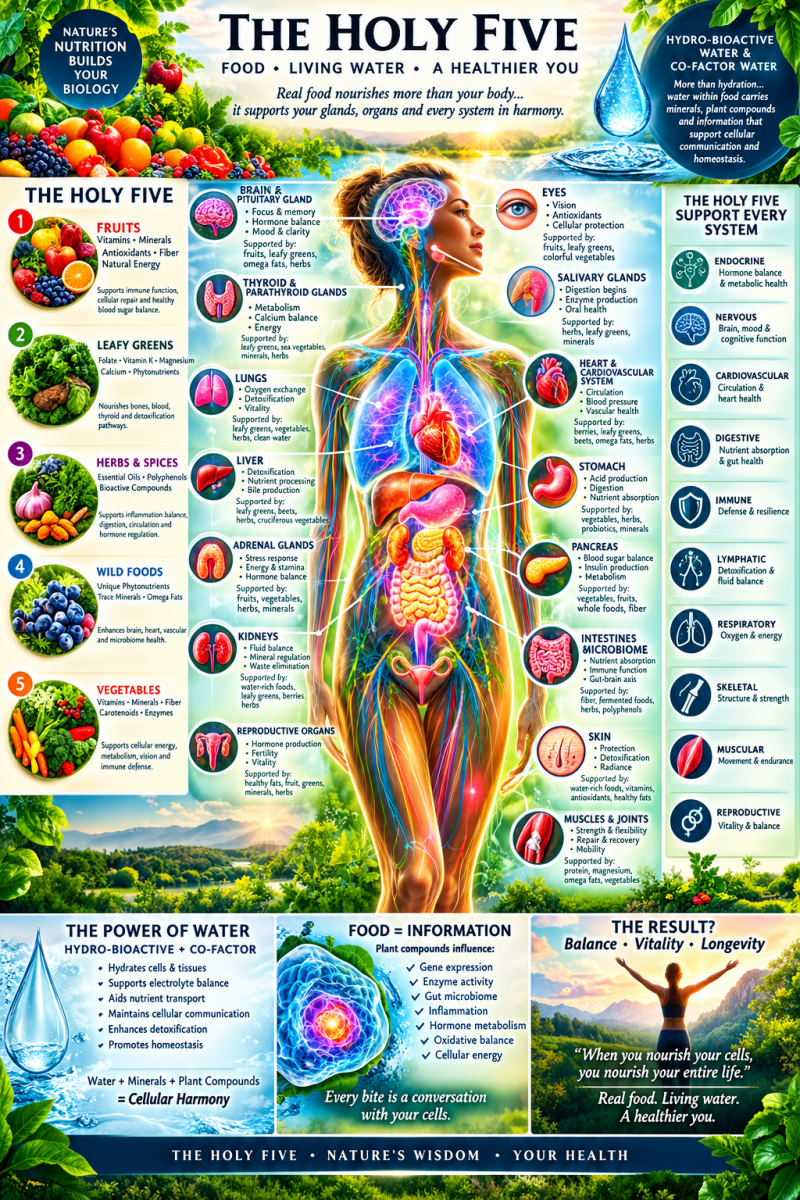
“Nourish your cells, and you nourish your whole life.”
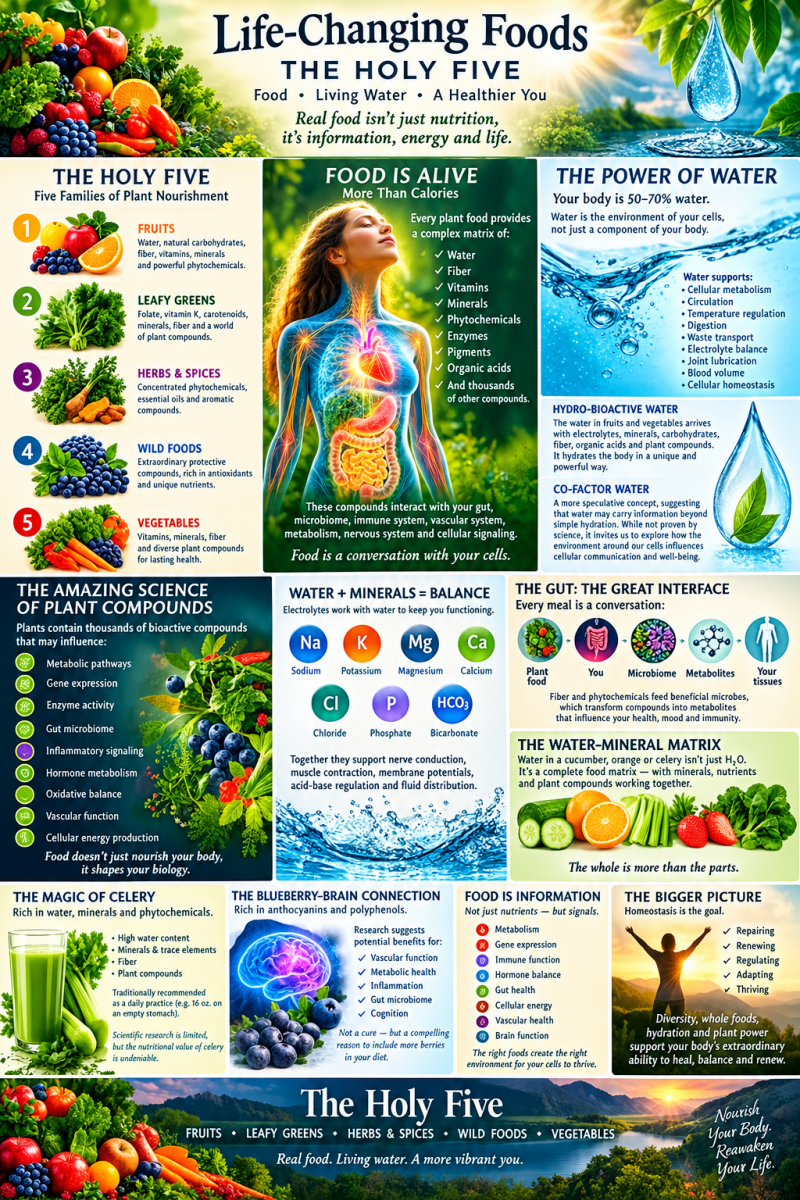
LIFE-CHANGING FOODS
The Holy Five, Living Water & the Hidden Architecture of Human Nourishment
What if food is more than calories, more than vitamins, and more than fuel?
What if the foods growing around us are not merely collections of carbohydrates, proteins, fats, vitamins and minerals—but extraordinarily complex biological packages containing thousands of compounds capable of communicating with the living systems of the human organism?
What if nourishment is not simply about what we eat, but about the information, minerals, phytochemicals, water, enzymes, pigments, fibers and plant compounds arriving at the cellular environment?
And what if one of the most overlooked components of food is not a nutrient at all?
Water💧
Not merely water as a chemical formula, H₂O, but water delivered within the living architecture of fruits, vegetables, leafy greens, herbs and wild foods.
This is one of the most fascinating concepts associated with Anthony William's Life-Changing Foods: the idea that certain plant foods provide not only nutrition but forms of what he calls living water—including what he describes as hydro-bioactive water and co-factor water.
His framework is expansive, unconventional and not fully supported by conventional biomedical research. Yet it invites a profound question:
Could the quality of what enters the human organism influence the quality of the environment in which every cell must live?
That question deserves our attention.
THE HOLY FIVE
In the expanded edition of Life-Changing Foods, Anthony William organizes his life-changing foods into five great botanical categories—what he calls The Holy Five:
1. FRUITS 🍎
2. LEAFY GREENS 🥬
3. HERBS & SPICES 🌿
4. WILD FOODS 🫐
5. VEGETABLES 🥦
The expanded edition contains extensive sections devoted to these categories, including dozens of individual foods such as apples, berries, bananas, citrus, leafy greens, celery, cilantro, garlic, ginger, wild blueberries, dandelion, coconut, potatoes, sweet potatoes and many others.
There is something almost poetic about this organization.
Five kingdoms of nourishment.
Five different expressions of plant life.
Five enormous reservoirs of biological compounds entering the human diet.
And beneath them all is something they share:
water.
THE FIRST REVELATION: FOOD IS ALIVE WITH COMPLEXITY
A modern food label might tell us:
- calories
- protein
- carbohydrates
- fat
- fiber
- vitamin C
- potassium
- iron
But that label represents only a fraction of what exists inside the food.
Plants manufacture an extraordinary diversity of compounds—polyphenols, flavonoids, carotenoids, pigments, organic acids, volatile compounds, fibers and numerous other phytochemicals.
Many of these compounds interact with the human organism indirectly through pathways involving:
the gut → microbiome → immune system → vascular system → metabolism → nervous system → cellular signaling.
This is why modern nutritional science increasingly views food as something considerably more sophisticated than a simple collection of isolated nutrients.
Consider the humble blueberry.
Blueberries contain anthocyanins and numerous other polyphenolic compounds. Research has investigated their potential relationships with vascular function, metabolic health, inflammation, the gut microbiome and cognition.
A 2024 systematic review of human trials found evidence suggesting beneficial effects of anthocyanin intake on some measures of cognition and vascular function, although effects on blood pressure and endothelial markers were not uniformly consistent.
A 2026 meta-analysis of randomized trials found that blueberry interventions improved flow-mediated dilation—a measure of vascular endothelial function—but did not demonstrate significant improvements in several cognitive outcomes among healthy individuals.
That distinction is important.
It tells us something beautiful about science:
A food can be biologically fascinating without every claim about it being proven.
THE HOLY FIVE ARE NOT FIVE FOODS
This distinction is crucial.
The Holy Five are not five individual foods.
They are five great families of plant nourishment.
FRUITS 🍎
Fruits provide water, natural carbohydrates, fiber, vitamins, minerals and an extraordinary diversity of phytochemicals.
Apples.
Oranges.
Mangoes.
Bananas.
Berries.
Melons.
Grapes.
Pomegranates.
Watermelon.
Pears.
Citrus.
The list continues almost endlessly.
Fruits also provide something particularly important to the human organism:
Glucose.
Glucose is not simply something to fear.
It is a fundamental metabolic substrate. The brain depends heavily on glucose under ordinary physiological conditions, while virtually every cell possesses mechanisms for using glucose as an energy source.
The deeper nutritional question is therefore not simply:
"Is sugar present?"
It is:
What biological package is delivering it?
A whole fruit arrives with water, fiber, minerals, polyphenols and other plant compounds—not merely isolated sugar.
LEAFY GREENS 🥬
If fruits are brilliant biochemical packages, leafy greens are magnificent mineral-and-phytochemical matrices.
Spinach.
Lettuce.
Kale.
Collards.
Arugula.
Broccoli greens.
Cabbage.
Sprouts.
Microgreens.
These foods provide folate, vitamin K, carotenoids, minerals, fiber and an immense variety of phytochemicals.
And their significance extends beyond the nutrients listed on a nutrition label.
Plant compounds can interact with the gut microbiome and with cellular signaling pathways.
The organism is not merely absorbing nutrients.
It is responding to an extraordinarily complex chemical environment.
Imagine every meal as a message.
Not a single message.
A multidimensional biological conversation.
HERBS & SPICES 🌿
Then there are the plants we traditionally use in smaller quantities.
They may occupy only a tiny corner of the plate, yet their chemical diversity can be extraordinary.
Cilantro
Garlic
Ginger
Turmeric
Basil
Parsley
Fennel
Rosemary
Thyme
Mint
Lemon balm
Herbs and spices contain concentrated phytochemicals responsible for their aromas, flavors, pigments and biological activities.
Their fragrance alone is evidence of chemical complexity.
That aroma is not accidental.
It is chemistry.
The essential oils, polyphenols, sulfur compounds and other constituents produced by plants represent sophisticated evolutionary adaptations.
When we consume them, those compounds enter another biological ecosystem:
ours.
WILD FOODS 🫐
Wild foods occupy a particularly fascinating place in William's philosophy.
Among those emphasized in Life-Changing Foods are:
wild blueberries, dandelion, elderberries, nettle leaf, wild herbs, coconut, aloe vera and Atlantic sea vegetables, among others.
Wild plants must survive.
They encounter sunlight.
Cold.
Heat.
Drought.
Predators.
Microorganisms.
Competition.
Environmental stress.
To survive, plants manufacture protective compounds.
This does not mean that every compound produced by a wild plant automatically becomes a therapeutic agent in the human body.
But it does mean that the chemistry of plants is deeply connected to the environments in which those plants evolved.
Wild blueberries provide an extraordinary example.
They are rich in anthocyanins and other polyphenols, and current research continues investigating their effects on vascular, metabolic, cognitive and gut health.
The science is still developing.
And that may be one of the most exciting parts.
VEGETABLES 🥦
Then we arrive at the great structural foods.
Potatoes.
Sweet potatoes.
Onions.
Radishes.
Peas.
Asparagus.
Artichokes.
Broccoli.
Cauliflower.
Green beans.
Squash.
Vegetables provide combinations of carbohydrate, fiber, minerals, vitamins and phytochemicals that can profoundly influence the nutritional landscape of the diet.
The potato is particularly interesting because nutritional science often reminds us that the context of a food matters.
A whole potato is not nutritionally equivalent to a highly processed potato product.
The same biological substance can exist inside radically different nutritional environments.
The matrix matters.
AND THEN COMES WATER
This is where the conversation becomes considerably more fascinating.
Approximately half to two-thirds of the human body is water, depending on factors such as age, sex and body composition.
Water is the medium in which countless biological reactions occur.
It participates in:
- cellular metabolism
- circulation
- temperature regulation
- digestion
- waste transport
- electrolyte balance
- joint lubrication
- maintenance of blood volume
- cellular homeostasis
The body does not merely contain water.
Life happens in water.
Every cell exists within a fluid environment.
Every nerve impulse depends upon electrochemical gradients.
Every heartbeat depends upon coordinated electrical and chemical activity.
Every muscle contraction depends upon ions moving through membranes.
Every biochemical reaction occurs within an aqueous biological environment.
Water is therefore not a peripheral detail of physiology.
It is the environment of physiology itself.
HYDRO-BIOACTIVE WATER
Anthony William uses the term hydro-bioactive water to describe water naturally present within fruits and vegetables and proposes that this form of water is particularly effective at hydrating the organism. This is part of his distinctive framework and should not be confused with an established medical classification of water.
Yet the underlying nutritional concept raises an intriguing question:
Is water delivered through whole foods physiologically identical to water consumed by itself?
Not necessarily in every respect.
When you eat watermelon, cucumber, oranges, celery, berries or lettuce, the water arrives embedded within a food matrix containing:
electrolytes + carbohydrates + fiber + organic acids + minerals + phytochemicals + plant cellular structures.
That changes the physiological context in which the water is consumed.
Think of a glass of water as a simple ingredient.
Now imagine water arriving inside a fruit.
The water is accompanied by an entire biological orchestra.
That distinction is fascinating.
THE WATER INSIDE THE FOOD
Consider a cucumber.
It is largely water.
But you do not experience that water as isolated H₂O.
You experience it as a complete food matrix.
The same principle applies to:
watermelon
oranges
strawberries
celery
tomatoes
cucumbers
grapes
melons
leafy greens
The organism receives fluid together with minerals, carbohydrates and plant compounds.
This is one reason water-rich fruits and vegetables can make such a meaningful contribution to overall hydration.
And it leads us toward an even more intriguing concept.
CO-FACTOR WATER
William also describes what he calls co-factor water, assigning to it a role involving information and support beyond simple hydration.
This concept is much more speculative.
There is currently no established biomedical evidence demonstrating that water contains a measurable "co-factor" that carries information capable of restoring the soul, spirit or emotions in the manner described in William's framework.
That distinction should not be hidden.
But neither does it make the underlying question uninteresting.
Because biology already teaches us something profound:
Information matters.
DNA contains information.
RNA carries information.
Hormones transmit information.
Neurotransmitters transmit information.
Cell-surface receptors receive information.
Electrical gradients transmit information.
The immune system communicates through molecular signals.
The nervous system is essentially an extraordinary information-processing network.
So the legitimate scientific question is not whether water magically stores emotional information—that remains unestablished.
The legitimate question is:
How does the physical and chemical environment surrounding cells influence cellular signaling and homeostasis?
That question is firmly within modern biology.
THE HUMAN ORGANISM AS AN AQUATIC NETWORK
Now step inside the body.
Picture a single cell.
Its membrane separates two environments.
Outside:
interstitial fluid.
Inside:
intracellular fluid.
Between those environments are gradients of:
- sodium
- potassium
- calcium
- chloride
- hydrogen ions
- nutrients
- metabolites
- signaling molecules
The membrane is not simply a wall.
It is a highly sophisticated communication interface.
Channels open.
Channels close.
Ions move.
Electrical potentials change.
Signals propagate.
Proteins change shape.
Enzymes accelerate reactions.
Mitochondria generate ATP.
DNA is transcribed.
Proteins are synthesized.
And all of it occurs within a water-based biological environment.
This is why hydration is not merely about "drinking enough."
Hydration is fundamentally connected to homeostasis.
THE MINERAL–WATER CONNECTION
Water alone is not the entire story.
Electrolytes matter.
Sodium.
Potassium.
Magnesium.
Calcium.
Chloride.
Phosphate.
Bicarbonate.
These ions participate in nerve conduction, muscle contraction, membrane potentials, acid-base regulation and fluid distribution.
This is one reason the mineral content of foods matters.
A food does not simply contribute water.
It may contribute the electrolytes and other compounds that help determine how the organism manages that water.
This is where leafy greens, fruits, vegetables, herbs and mineral-rich foods become particularly fascinating.
Water and minerals operate as a physiological partnership.
THE CELLULAR WATERFALL
Imagine drinking a glass of water.
It travels through the gastrointestinal tract.
It is absorbed.
It enters the circulation.
It distributes through extracellular compartments.
It crosses membranes according to osmotic and transport forces.
It becomes part of the dynamic fluid environment surrounding and within cells.
Now imagine receiving water repeatedly throughout the day through:
fruit + vegetables + leafy greens + herbs + soups + clean drinking water.
Suddenly hydration is no longer an isolated event.
It becomes a continuous nutritional process.
Morning.
Afternoon.
Evening.
Meal after meal.
Cell after cell.
CELERY: THE WATER–MINERAL MATRIX
Few foods have become as closely associated with Anthony William as celery.
William recommends straight celery juice and describes it as a particularly important component of his approach. His official website recommends approximately 16 ounces of plain celery juice on an empty stomach and acknowledges that clinical research specifically testing that practice remains limited.
That caveat matters.
There are studies on celery as a plant and its constituents, but that is not the same as proving every claim made about celery juice.
Still, celery is nutritionally fascinating.
It contains a high proportion of water and provides minerals, fiber and phytochemicals.
William's framework places special emphasis on what he calls celery's "cofactor micro trace mineral salts."
From a scientific perspective, the exact biological claims associated with those proposed compounds require substantially more investigation.
But the broader nutritional principle is sound:
Minerals and plant compounds matter.
THE BLUEBERRY–BRAIN CONNECTION
The brain is perhaps where the story becomes most captivating.
The human brain is an extraordinarily metabolically active organ.
It requires:
oxygen + glucose + water + electrolytes + micronutrients + constant blood flow.
Now introduce a food such as the blueberry.
Its anthocyanins and other polyphenols are being investigated for effects on vascular function, oxidative processes, inflammation, gut microbiota and cognition.
Research does not justify declaring blueberries a cure for neurological disease.
But it does justify fascination.
A 2021 systematic review of randomized controlled trials found that berry anthocyanin interventions were associated with improvements in some memory measures and vascular endothelial function, while metabolic effects were less consistent.
And a newer 2026 meta-analysis found a measurable improvement in vascular function following blueberry interventions, while cognitive effects remained inconclusive in healthy participants.
This is precisely where responsible holistic nutrition becomes powerful:
We don't need to exaggerate the evidence to appreciate the biology.
FOOD IS INFORMATION — BUT LET'S DEFINE THAT CAREFULLY
The phrase "food is information" is often used in holistic health.
Scientifically, it can be understood in a meaningful way without requiring mystical assumptions.
Food changes the chemical environment of the organism.
That environment affects:
- metabolic pathways
- gene expression
- enzyme activity
- gut microbial composition
- inflammatory signaling
- hormone metabolism
- oxidative balance
- vascular signaling
- cellular energy production
Food therefore carries biological signals.
Not necessarily in the sense that a food is sending a conscious message to a cell.
Rather, its molecular constituents interact with biological systems.
A flavonoid can interact with a receptor or signaling pathway.
A fatty acid can influence membrane composition.
A mineral can serve as an enzyme cofactor.
A carbohydrate can alter substrate availability.
A fiber can become fuel for intestinal microorganisms.
A phytochemical can be metabolized into another biologically active compound.
The complexity is astonishing.
THE GUT: THE GREAT INTERFACE
The gastrointestinal tract is not simply a pipe through which food passes.
It is an enormous biological interface between the outside world and the internal organism.
Every meal introduces foreign molecules.
The body must determine:
What should be absorbed?
What should remain in the intestinal tract?
What should be metabolized?
What should be transformed by microbes?
What should be eliminated?
The gut microbiome adds another layer.
Plant fibers and phytochemicals interact with microorganisms, which can transform food compounds into metabolites that subsequently interact with human physiology.
The meal therefore becomes a conversation involving:
plant → human → microbiome → metabolites → human tissues.
That is a remarkable biological ecosystem.
THE HOLY FIVE AS A DIVERSITY STRATEGY
Perhaps one of the most useful ways to understand the Holy Five is not as a rigid prescription.
Instead, consider them a diversity principle.
Eat the colors.
Eat the seasons.
Eat the leaves.
Eat the roots.
Eat the berries.
Eat the herbs.
Eat the fruits.
Eat the vegetables.
Explore appropriately prepared wild foods.
Different plants provide different combinations of:
fiber + minerals + vitamins + polyphenols + pigments + organic compounds + water.
No single food needs to perform every biological function.
The organism is designed for complexity.
THE DEEPEST LEVEL: HOMEOSTASIS
Ultimately, the deepest story is not about one miracle food.
It is about homeostasis.
Your body is continuously attempting to maintain an extraordinarily narrow range of internal conditions.
Temperature.
pH.
Electrolytes.
Glucose.
Blood pressure.
Osmotic balance.
Oxygen.
Carbon dioxide.
Energy availability.
Hormonal signaling.
Fluid distribution.
The organism is constantly adjusting.
Minute by minute.
Second by second.
You are not a static structure.
You are a living process.
And nutrition supplies many of the raw materials with which that process operates.
THE BODY DOES NOT EXPERIENCE FOOD AS A LIST
Your body does not encounter an apple and say:
Vitamin C: 8.4 mg.
It encounters an entire biological matrix.
Water.
Fructose.
Glucose.
Fiber.
Organic acids.
Polyphenols.
Minerals.
Aromatic compounds.
Pigments.
And thousands of other molecules.
The same is true of a blueberry.
A potato.
A leafy green.
A tomato.
A sprig of parsley.
A stalk of celery.
This is why the concept of food matrix is so important.
The whole can behave differently from the isolated parts.
A WORD ABOUT "DETOX"
Anthony William places considerable emphasis on detoxification and describes several foods as having specific abilities to address heavy metals and other burdens. For example, his Heavy Metal Detox Smoothie combines wild blueberries, cilantro, barley grass juice powder, spirulina and Atlantic dulse.
These claims should be distinguished from established clinical evidence.
The human body already possesses sophisticated detoxification and elimination systems involving the:
liver → kidneys → gastrointestinal tract → lungs → skin.
Nutrition can support normal physiological function, but no food should be represented as a guaranteed treatment for heavy-metal poisoning or chronic disease.
Actual toxic exposures require appropriate medical evaluation and evidence-based treatment.
Still, the foods themselves can be nutritionally valuable.
And that distinction allows us to preserve what is beautiful without overstating what has not been proven.
THE FIVE AS A DAILY PHILOSOPHY
Imagine beginning each day with a simple question:
How much living plant diversity can I bring into this organism today?
Perhaps:
A citrus fruit.
A handful of berries.
Leafy greens.
Fresh herbs.
Celery.
A potato or sweet potato.
A colorful vegetable.
A wild food.
A mineral-rich food.
Clean water.
Not because one item is magical.
But because biological systems thrive on appropriate inputs, diversity and balance.
THE WATER WITHIN THE FOOD
There is another word worth remembering:
matrix.
Water in a cucumber exists within a matrix.
Water in an orange exists within a matrix.
Water in a strawberry exists within a matrix.
Water in celery exists within a matrix.
Water in leafy greens exists within a matrix.
The human body itself is also a matrix.
Cells.
Proteins.
Membranes.
Fluids.
Electrolytes.
Connective tissues.
Blood.
Lymph.
Extracellular matrix.
Intracellular compartments.
Nothing exists in isolation.
Everything exists in relationship.
That may be one of the most profound lessons hidden within the conversation about food and water.
A FINAL WORD ON HYDRO-BIOACTIVE AND CO-FACTOR WATER
It is tempting to turn these concepts into extraordinary claims.
But perhaps there is something more intellectually beautiful than that.
We can hold the concepts with curiosity rather than certainty.
William's idea of hydro-bioactive water offers a way of thinking about the water naturally present in plant foods.
His concept of co-factor water extends that idea into a more speculative territory involving information and the emotional or spiritual dimensions of life.
Modern science has not established those concepts as medical facts.
But modern physiology does establish something extraordinary:
Water is indispensable to life.
Electrolytes govern critical biological processes.
Food chemistry influences physiology.
Plant compounds interact with human biology.
The gut microbiome transforms dietary compounds.
Vascular function responds to nutritional inputs.
Cellular metabolism depends upon a precisely regulated aqueous environment.
That is already astonishing.
We do not need to manufacture mystery.
Life itself is mysterious enough.
THE GREAT NUTRITIONAL REVELATION
Perhaps the most transformative realization is this:
You do not eat merely to fill your stomach.
You eat to participate in the continuous rebuilding and regulation of a living organism.
Every day, your body is:
repairing membranes.
manufacturing proteins.
producing neurotransmitters.
maintaining blood vessels.
regulating electrolytes.
supporting immune defenses.
generating ATP.
maintaining DNA.
recycling cellular components.
communicating between tissues.
maintaining temperature.
maintaining fluid balance.
And the materials required for this extraordinary enterprise come, ultimately, from the environment.
From sunlight.
From air.
From water.
From soil.
From plants.
From food.
And from the intricate relationship between all of them.
THE HOLY FIVE: A RETURN TO THE LIVING WORLD
The deepest invitation of Life-Changing Foods may therefore be simpler than any individual protocol.
Return to real food.
Return to color.
Return to variety.
Return to plants.
Return to mineral-rich foods.
Return to water-rich foods.
Return to the extraordinary diversity of the botanical world.
Let an apple be an apple.
Let a blueberry be a blueberry.
Let a leaf be a leaf.
Let celery be celery.
Let herbs remain herbs.
Let vegetables remain vegetables.
Let food retain its complexity.
Because perhaps one of the greatest nutritional mistakes of the modern age has been our tendency to reduce food into isolated numbers.
Calories.
Carbs.
Protein.
Fat.
Vitamin.
Mineral.
Supplement.
Pill.
Powder.
Yet life does not operate as a spreadsheet.
Life operates as an integrated system.
And perhaps that is where the true magnificence of food begins.
THE FINAL WORD
Imagine, for a moment, a single glass of water.
It appears almost empty.
Transparent.
Simple.
Ordinary.
Now imagine a living plant absorbing water from the earth.
Sunlight strikes its leaves.
Carbon dioxide enters.
Minerals arrive through its roots.
Photosynthesis transforms energy.
Sugars are manufactured.
Pigments are created.
Polyphenols are synthesized.
Fibers are constructed.
Organic acids emerge.
The plant builds itself from sunlight, water, air and minerals.
Then you eat it.
And its molecular legacy becomes part of you.
Some compounds are absorbed.
Some are transformed.
Some nourish microbes.
Some are excreted.
Some become metabolic intermediates.
Some interact with cellular pathways.
Some contribute to the environment in which your cells live.
The boundaries between earth, plant, food and human being suddenly become less absolute.
The apple becomes chemistry.
The chemistry becomes metabolism.
The metabolism becomes energy.
The energy becomes movement.
The movement becomes life.
And water flows through the entire story.
That is the wonder.
Not that one food is a miracle.
But that ordinary food participates in an extraordinary biological process every moment of every day.
The Holy Five remind us to look again at what nature has placed before us:
Fruits.
Leafy greens.
Herbs & spices.
Wild foods.
Vegetables.
And behind them all:
water, minerals, sunlight, soil, biology and life.
Perhaps the greatest nutritional revelation is not discovering one perfect food.
It is rediscovering the profound intelligence contained within diversity, whole foods, hydration and the remarkable capacity of the human organism to continually regulate, adapt and renew itself.
"Food is not merely something we consume. It is part of the environment from which the living organism continually builds itself."