"Exercise is an investment in healthspan and longevity."
🏃♀️ EXERCISE 🏃
The Most Powerful Medicine We Already Possess
Every movement is a biological message.
What if one of the most powerful interventions known to modern medicine was not manufactured in a laboratory?
What if it could not be patented?
What if it required no prescription, no pharmacy, no sophisticated machine and no complicated protocol?
What if the “medicine” was already built into you?
Your muscles.
Your heart.
Your lungs.
Your nervous system.
Your mitochondria.
Your bones.
Your blood vessels.
Your brain.
And the extraordinary biological intelligence connecting them all.
That medicine is movement.
More specifically:
EXERCISE.
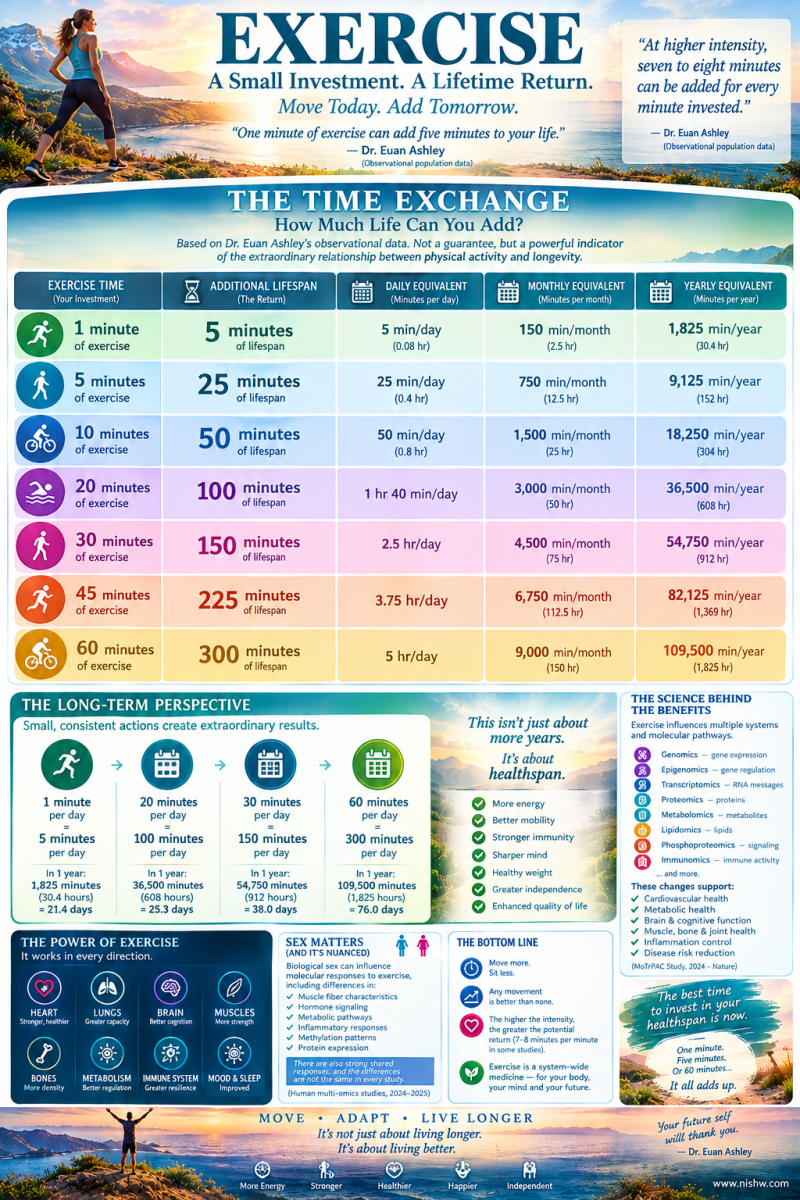
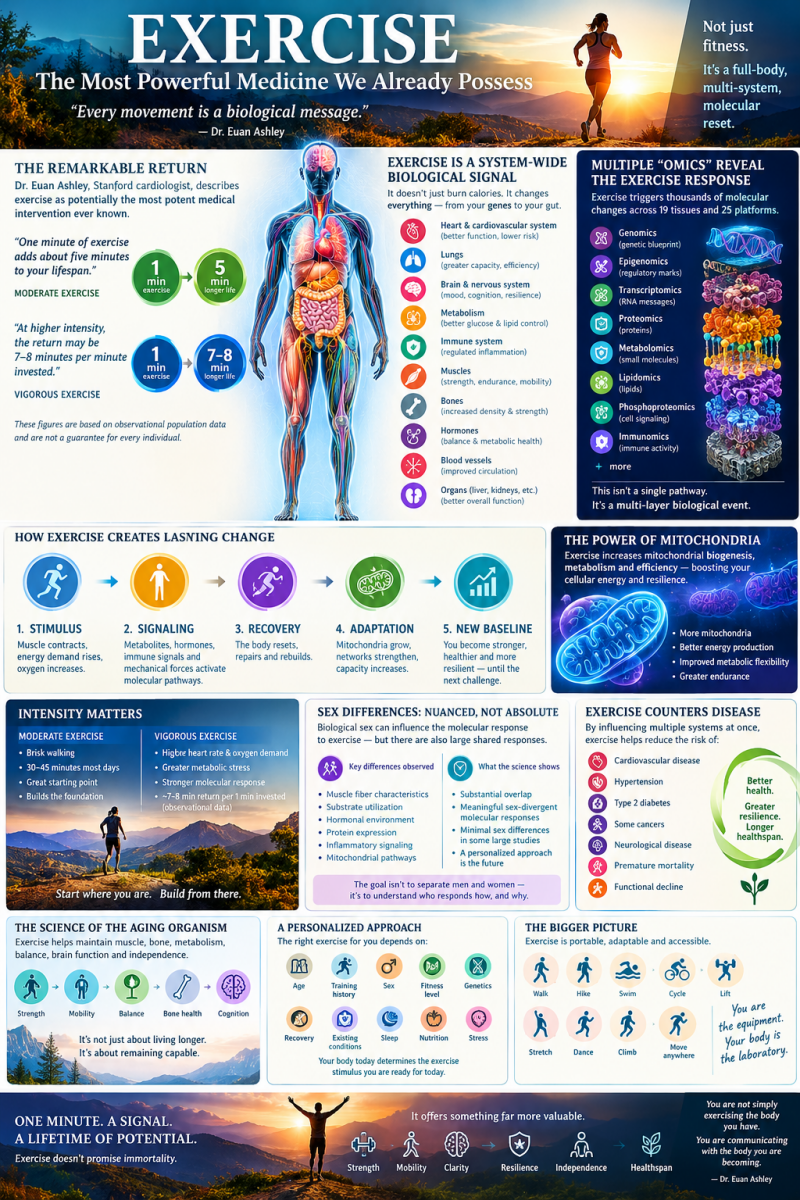
Stanford cardiologist and physician-scientist Dr. Euan Ashley has described exercise as potentially “the most potent medical intervention ever known.” In discussing the extraordinary return on investment associated with physical activity, Ashley has explained that observational data support a striking relationship: approximately one minute of exercise associated with five minutes of additional life, while higher-intensity exercise can produce an estimated seven or eight minutes of additional life per minute invested when the same type of population-level calculation is applied.
That statement deserves an important qualification.
It is not a promise that every individual literally receives five—or seven or eight—additional minutes of life for every minute exercised. These figures are memorable interpretations of observational population data, not a biological stopwatch operating inside every human being. Ashley himself has acknowledged the observational nature of the evidence and the limitations of extrapolating the numbers literally.
Yet the underlying message may be even more extraordinary than the slogan:
Exercise produces an enormous return on biological investment.
And modern science is beginning to reveal why.
ONE MINUTE IN.
FIVE MINUTES OUT.
And at higher intensity, approximately seven to eight.
Imagine being able to invest one minute of your life and potentially receive several minutes of additional life in return.
Again, this is not a literal guarantee.
It is a way of expressing the extraordinary association between physical activity and longevity observed across large populations.
Ashley has used this concept specifically to challenge one of the most common objections to exercise:
“I don't have time.”
His response is essentially:
You may not have time not to move.
The question is no longer merely:
“How much time does exercise take?”
The more provocative question becomes:
“How much future biological capacity might inactivity be costing?”
EXERCISE IS NOT SIMPLY CALORIE EXPENDITURE
For decades, exercise was frequently reduced to a simple equation:
Calories in → calories out.
But modern molecular biology is revealing something far more profound.
Exercise is not merely a mechanism for burning energy.
Exercise is a biological signal.
A muscle contracts.
Mechanical forces change.
Energy demand rises.
ATP consumption increases.
Blood flow changes.
Oxygen utilization changes.
Metabolites accumulate.
Hormonal signals shift.
Immune signals change.
Gene expression changes.
Protein activity changes.
Epigenetic patterns can change.
Mitochondria respond.
The nervous system responds.
The cardiovascular system responds.
The immune system responds.
The metabolic system responds.
And eventually—
the organism adapts.
Exercise is therefore not merely something we do to our bodies.
It is something our bodies interpret.
THE BODY'S MOLECULAR RESPONSE
This is where exercise becomes almost breathtaking.
The Molecular Transducers of Physical Activity Consortium—MoTrPAC—was established specifically to understand what happens molecularly when humans and other mammals exercise.
In a landmark 2024 Nature study, researchers examined endurance exercise across 19 tissues and 25 molecular platforms, incorporating transcriptomics, proteomics, metabolomics, lipidomics, phosphoproteomics, acetylproteomics, ubiquitylproteomics, epigenomics and immunomics. The study identified thousands of exercise-responsive molecular changes across tissues.
Think about what that means.
Exercise isn't changing one molecule.
It isn't changing one organ.
It isn't acting through one pathway.
It is creating a molecular ripple throughout the organism.
The heart.
Liver.
Kidneys.
Lungs.
Brain.
Adipose tissue.
Skeletal muscle.
Blood.
Adrenal glands.
Intestine.
And more.
The body doesn't respond to exercise as a collection of disconnected parts.
It responds as an interconnected biological network.
MULTIPLE “OMICS” REVEAL THE EXERCISE RESPONSE
The word omics represents a new way of understanding biology.
Instead of looking at one molecule at a time, researchers can examine entire molecular layers.
Genomics
The underlying genetic blueprint.
Epigenomics
Chemical and regulatory marks that influence how genes are expressed.
Transcriptomics
The RNA messages being produced from genes.
Proteomics
The proteins actually present and functioning within cells.
Metabolomics
The small molecules and metabolic products reflecting cellular activity.
Lipidomics
The body's vast landscape of lipids and lipid signaling.
Phosphoproteomics
Changes in protein phosphorylation—one of the fundamental ways cellular signaling is regulated.
Immunomics
The molecular landscape of immune activity.
And beyond.
When these layers are examined together, something remarkable emerges.
Exercise is not a single-pathway intervention.
It is a multi-layer biological event.
THE BODY DOESN'T JUST “GET FIT”
It rewrites its response to demand.
In the MoTrPAC endurance-training study, researchers observed widespread molecular changes involving:
- mitochondrial pathways
- metabolic regulation
- immune responses
- stress-response pathways
- tissue remodeling
- cardiovascular biology
- energy production
- recovery processes
The researchers also identified molecular changes relevant to conditions including cardiovascular disease, metabolic disease, inflammatory bowel disease, liver disease and tissue injury and recovery.
This provides a remarkable biological explanation for something clinicians have observed for generations:
Exercise appears to influence disease risk across multiple systems because it influences multiple systems.
MITOCHONDRIA: THE CELLULAR POWER PLANTS RESPOND
Every movement requires energy.
That energy comes largely through ATP.
And mitochondria are central to the production of ATP.
When exercise increases energy demand, mitochondria become part of the adaptive response.
With repeated endurance training, researchers have observed molecular changes associated with mitochondrial metabolism, mitochondrial biogenesis and protein translation in skeletal and cardiac muscle.
This is profound.
The body doesn't merely become accustomed to exercising.
It changes its molecular machinery for meeting the energetic demand.
The organism learns how to become more capable of producing and utilizing energy.
EXERCISE AND THE HEART
The heart is a muscle.
It responds to demand.
During exercise, cardiac output rises.
Blood flow is redistributed.
Oxygen delivery increases.
The cardiovascular system is challenged to perform.
Repeated appropriate exercise can improve cardiorespiratory fitness and cardiovascular function while being associated with lower risk of cardiovascular disease and mortality.
But the deeper insight is this:
You are not merely exercising your muscles.
You are exercising the system that supplies every cell with oxygen and nutrients.
Every heartbeat participates.
Every vessel participates.
Every capillary becomes part of the physiological response.
Exercise therefore becomes a kind of cardiovascular rehearsal for life.
EXERCISE AND METABOLIC HEALTH
Skeletal muscle is one of the body's great metabolic organs.
When it contracts, it consumes energy.
Glucose utilization changes.
Fat metabolism changes.
Insulin signaling changes.
Mitochondrial activity changes.
Repeated exercise can therefore influence the body's ability to manage energy.
The molecular evidence is increasingly consistent with this broader picture.
Exercise-responsive genes, proteins and metabolites participate in pathways involving energy metabolism, glucose regulation, lipid utilization and mitochondrial function.
This is one reason physical activity is so strongly associated with reduced risk of metabolic disease.
Muscle is not merely tissue that moves.
Muscle is metabolic infrastructure.
EXERCISE AND INFLAMMATION
Inflammation is essential.
Without it, the body could not respond appropriately to injury or infection.
But chronic dysregulation is another matter.
Exercise interacts with immune signaling at multiple levels.
The MoTrPAC research identified widespread exercise-associated regulation of immune pathways and inflammatory signaling across tissues.
Exercise therefore appears to act less like an on/off switch for inflammation and more like a regulatory stimulus influencing the complex immune environment.
That distinction matters.
The objective is not to eliminate inflammation.
The objective is appropriate biological regulation.
EXERCISE AND DISEASE: A MULTI-SYSTEM DEFENSE
One of exercise's most extraordinary characteristics is the breadth of disease processes with which it is associated.
Regular physical activity is associated with reduced risk of:
- cardiovascular disease
- hypertension
- type 2 diabetes
- some cancers
- neurological disease
- premature mortality
- functional decline
It also supports mental health, cognition, sleep and physical function.
Why?
Because disease rarely exists in isolation.
Metabolism affects inflammation.
Inflammation affects vascular function.
Vascular function affects the brain.
Mitochondrial function affects energy availability.
Muscle affects glucose handling.
Physical function affects independence.
The systems overlap.
Therefore, an intervention capable of influencing many systems simultaneously can have extraordinarily broad consequences.
THE SEX DIFFERENCE
One of the most important developments in modern exercise science is the recognition that biological sex can influence the molecular response to exercise.
Historically, much exercise research relied disproportionately on male participants.
That created an important scientific blind spot.
Researchers now increasingly ask:
Does the same exercise stimulus produce precisely the same biological response in males and females?
The answer appears to be:
Not always.
A 2024 multi-omic human study examined young exercise-naïve men and women using skeletal-muscle and extracellular-vesicle transcriptomics, whole-blood methylomics and serum metabolomics. Researchers found substantial overlap in the response to exercise—but also meaningful sex-divergent molecular responses.
This is precisely why the future of exercise medicine is moving toward greater biological precision.
SEX IS NOT A FOOTNOTE
Sex-related differences have been observed in:
- muscle fiber characteristics
- substrate utilization
- cardiorespiratory capacity
- hormonal environment
- protein expression
- metabolic responses
- methylation patterns
- inflammatory signaling
- exercise adaptation
But the emerging science is nuanced.
A 2025 human multi-omics analysis involving more than 1,000 participants and 2,340 muscle samples found strong molecular signatures associated with exercise adaptation and VO₂max, while reporting minimal sex differences across the integrated molecular response.
Other research has identified sex differences in particular protein responses and mitochondrial pathways without finding sex-dependent changes in every molecular layer.
This is an important lesson:
Biological sex matters—but it does not mean males and females live in completely separate exercise universes.
There are enormous shared responses.
There are also meaningful differences.
The science is moving toward understanding which differences matter, when they matter, and for whom they matter.
EXERCISE IS PERSONALIZED BIOLOGY
The future question may not be:
“What is the best exercise?”
It may become:
“What is the most appropriate exercise stimulus for this individual, at this particular stage of life, given this person's biology and goals?”
Age matters.
Training history matters.
Sex matters.
Fitness matters.
Genetics matter.
Recovery matters.
Existing disease matters.
Sleep matters.
Nutrition matters.
Stress matters.
And perhaps most importantly:
The body you have today determines the exercise stimulus you are ready for today.
That is why intelligent exercise is progressive rather than reckless.
MODERATE EXERCISE: THE FOUNDATION
Not everyone needs to sprint.
Not everyone needs to lift maximal weights.
Not everyone needs high-intensity interval training.
For many people, brisk walking represents a remarkably accessible starting point.
Ashley has specifically emphasized that any movement is better than none, suggesting that sedentary individuals can begin simply by standing, walking and gradually increasing activity. He has described 30–45 minutes of moderate activity such as brisk walking on most days as a strong target for people who can safely perform it.
The first victory is not intensity.
The first victory is movement.
THEN COMES INTENSITY
Once appropriate conditioning exists, another dimension becomes available:
Intensity.
Higher-intensity exercise creates a substantially different physiological demand.
Heart rate rises.
Ventilation rises.
Oxygen demand rises.
ATP turnover rises.
Metabolic stress rises.
Neuromuscular recruitment changes.
The body is forced to respond to a larger biological challenge.
And this is where Ashley's striking seven-to-eight-minute return enters the conversation.
He has stated that when the longevity relationship is considered at somewhat higher intensity, the estimated return rises to approximately seven or eight minutes of additional life for each minute invested.
Again:
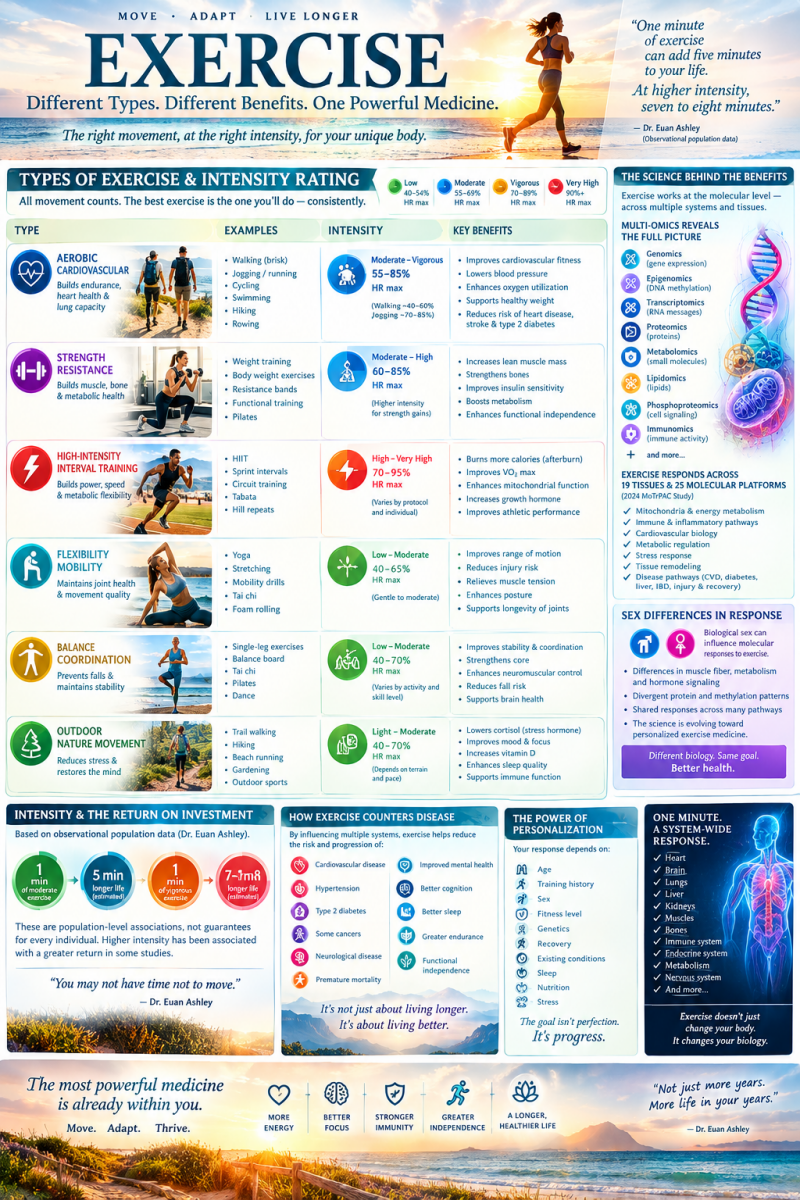
This is an observational population-level illustration—not a prescription to perform maximal exercise and not a guarantee of lifespan extension.
For someone untrained, older, injured, or living with cardiovascular or other medical conditions, vigorous exercise may be inappropriate without individualized medical guidance.
The lesson is not:
“Go harder at all costs.”
The lesson is:
Appropriate intensity can create a powerful biological stimulus.
THE MOLECULAR RESPONSE TO INTENSITY
Exercise intensity influences the magnitude and character of physiological stress.
As demand increases, the molecular environment changes.
Energy sensors are activated.
Metabolites shift.
Redox signaling changes.
Gene expression changes.
Protein phosphorylation changes.
Hormonal signaling changes.
Mitochondrial demand increases.
The immune environment responds.
And the recovery process begins.
Exercise is therefore a fascinating biological paradox:
The temporary stress of exercise can become the stimulus for greater resilience.
This is one reason exercise must be understood through the lens of stress + recovery + adaptation.
HORMESIS: THE BENEFICIAL STRESS
A controlled biological challenge can provoke an adaptive response.
Exercise is one of the clearest examples.
You stress the system.
The system recovers.
The system adapts.
And, within appropriate limits, it becomes better equipped to handle the next challenge.
This is fundamentally different from chronic uncontrolled stress.
The difference is:
Dose.
Too little stimulus may produce little adaptation.
Appropriate stimulus can produce adaptation.
Too much stimulus without recovery can become counterproductive.
The art of exercise therefore lies not merely in creating stress.
It lies in creating the right stress.
EXERCISE AND EPIGENETICS
Perhaps one of the most fascinating discoveries is that exercise can influence epigenetic biology.
Epigenetics does not rewrite the underlying DNA sequence.
Instead, it involves regulatory mechanisms that influence how genetic information is expressed.
Exercise-associated changes in DNA methylation and other regulatory layers have been observed in human studies. Multi-omic research has begun connecting exercise, DNA methylation, gene expression and protein-level adaptation.
This provides a remarkable conceptual shift:
Your genes are not the entire story.
The environment continually communicates with your biology.
And exercise is one of the most powerful environmental signals you can voluntarily create.
EXERCISE AND THE GENETIC BLUEPRINT
Your DNA is not simply a static instruction manual sitting quietly inside your cells.
Genes are regulated.
Genes are expressed.
Genes are silenced.
Genes communicate through RNA.
RNA contributes to protein production.
Proteins perform cellular work.
Metabolites reflect cellular activity.
Exercise influences portions of this enormous network.
That is why researchers increasingly describe exercise as a molecular transducer—a stimulus that is converted into biochemical information throughout the body.
The body receives the message:
“We are moving. We require more capacity.”
And biology begins responding.
THE BODY'S RESPONSE OCCURS ACROSS TIME
One of the remarkable findings from MoTrPAC is that exercise adaptation is not static.
Some molecular changes occur early.
Others emerge later.
Some are transient.
Others persist.
Some occur in one tissue.
Others appear across multiple tissues.
The temporal dimension matters enormously. Researchers observed distinct patterns across one, two, four and eight weeks of endurance training, demonstrating that the molecular response evolves as training continues.
This means that exercise is not simply:
Workout → result.
It is:
Stimulus → signaling → recovery → remodeling → adaptation → new baseline.
Then the next workout begins from that new baseline.
EXERCISE CREATES A NEW BIOLOGICAL NORMAL
This may be one of the most profound concepts in exercise physiology.
You begin with a certain capacity.
You challenge it.
You recover.
You adapt.
And eventually the body establishes a new baseline.
The staircase becomes easier.
The hill becomes shorter.
The heart rate response becomes more efficient.
The muscles become stronger.
The mitochondria become more capable.
The movement becomes coordinated.
The body becomes accustomed to doing what once seemed difficult.
The extraordinary becomes ordinary.
That is adaptation.
EXERCISE AND THE AGING ORGANISM
Aging changes physiology.
Muscle mass can decline.
Strength can decline.
Bone density can decline.
Cardiorespiratory capacity can decline.
Balance can decline.
Metabolic flexibility can decline.
But exercise can provide a continual biological stimulus opposing many components of functional decline.
This is why exercise should not be viewed merely as a strategy for looking younger.
It is a strategy for remaining capable.
The true currency of longevity is not simply years.
It is function.
HEALTHSPAN OVER LIFESPAN
What good is an additional decade if the body cannot participate in the life being lived?
Healthspan asks a different question:
How many years can I remain capable, mobile, independent and engaged?
Exercise may influence the biological systems underlying that capacity.
Strength.
Balance.
Cardiovascular fitness.
Metabolic health.
Bone health.
Neurological coordination.
Mood.
Sleep.
Functional independence.
The objective is not merely to make the clock run longer.
It is to preserve the machinery that allows you to experience what the clock is measuring.
EXERCISE AS A SYSTEM-WIDE MEDICINE
Consider the remarkable list:
Heart
Brain
Lungs
Liver
Kidneys
Skeletal muscle
Adipose tissue
Blood
Immune system
Vascular system
Endocrine system
Mitochondria
Bone
Connective tissue
Nervous system
Exercise communicates with all of them.
The 2024 MoTrPAC findings demonstrated the extraordinary breadth of these molecular adaptations across tissues and molecular platforms.
This may explain why exercise has such a remarkable reputation across so many areas of medicine.
Few interventions speak to the entire organism simultaneously.
THE MEDICINE THAT MOVES WITH YOU
There is another extraordinary characteristic of exercise:
It is portable.
You can walk almost anywhere.
You can perform body-weight movements almost anywhere.
You can climb stairs.
You can carry.
You can squat.
You can stretch.
You can dance.
You can swim.
You can cycle.
You can hike.
You can train with resistance.
You can move outdoors.
You can move indoors.
The body is the equipment.
The organism is the laboratory.
And every session becomes another experiment in adaptation.
THE MOST IMPORTANT REPETITION
You do not need one heroic workout.
You need a relationship with movement.
A single workout creates a stimulus.
Repeated exercise creates adaptation.
Consistent exercise creates a new way of living.
That is why the most important workout may not be the hardest workout.
It may be the workout you can consistently repeat.
ONE MINUTE.
ONE SIGNAL.
ONE ADAPTATION.
Imagine what happens when one minute becomes ten.
Ten becomes twenty.
Twenty becomes thirty.
Thirty becomes a habit.
The habit becomes a lifestyle.
And the lifestyle becomes part of the biological environment in which your cells operate.
That is when exercise becomes something much greater than fitness.
It becomes physiology.
THE QUESTION THAT CHANGES EVERYTHING
We often ask:
“How much time will exercise take from my day?”
Perhaps the better question is:
“How much biological capacity might exercise return to my life?”
Dr. Euan Ashley's five-minute—and higher-intensity seven-to-eight-minute—longevity illustrations are compelling precisely because they reverse the way we think about exercise.
Instead of viewing exercise as time lost:
View it as an investment.
An investment in cardiovascular reserve.
An investment in muscle.
An investment in mitochondrial capacity.
An investment in metabolic flexibility.
An investment in neurological function.
An investment in mobility.
An investment in independence.
An investment in healthspan.
And potentially—
an investment in longevity.
THE BODY IS LISTENING
Every time you move, your body receives information.
Every contraction sends a signal.
Every elevated heartbeat sends a signal.
Every increase in oxygen demand sends a signal.
Every challenge to balance sends a signal.
Every resistance exercise sends a signal.
Every recovery period allows the body to process that signal.
And every repeated exposure gives the organism another opportunity to adapt.
The emerging science of multi-omics is finally allowing researchers to see portions of this conversation at a depth never previously possible.
Thousands of molecular changes.
Multiple tissues.
Multiple biological layers.
Different time points.
Different exercise modalities.
Different responses between individuals.
And, in some circumstances, meaningful differences between the sexes.
We are beginning to see something that the human body has known all along:
Movement changes biology.
THE FINAL INVESTMENT
Exercise does not promise immortality.
It cannot guarantee a particular lifespan.
It cannot prevent every disease.
And vigorous exercise is not appropriate for everyone.
But the scientific evidence has become extraordinarily compelling that physical activity is one of the most powerful tools available for influencing health, function and longevity.
And now, molecular science is showing us something even deeper.
Exercise doesn't merely make the body feel different.
It changes the molecular environment in which the body operates.
Genes respond.
RNA responds.
Proteins respond.
Metabolites respond.
Lipids respond.
Immune pathways respond.
Mitochondria respond.
Blood vessels respond.
Muscle responds.
The brain responds.
The entire organism participates.
Perhaps that is why exercise has earned such an extraordinary description from Dr. Euan Ashley.
Not because exercise is merely another health recommendation.
But because it is one of the rare interventions capable of speaking simultaneously to so many dimensions of human biology.
So the next time you wonder whether you have time to exercise, remember:
One minute may be an investment.
Five minutes may be the population-level return associated with moderate exercise.
Higher intensity may produce an even greater estimated return—approximately seven to eight minutes in Ashley's illustration.
But the deepest return cannot be measured solely in minutes.
It may be measured in:
strength.
mobility.
clarity.
resilience.
independence.
capacity.
healthspan.
and the ability to continue participating fully in life.
"You are not simply exercising the body you have. You are communicating with the body you are becoming. And every movement is part of that conversation."
🏃♀️🏃