“Protect the cell, support the intelligence within.”
🔴 ASTAXANTHIN 🛡
The Red Shield of Cellular Protection, Oxidative Balance & Inflammation Control
A remarkable carotenoid at the intersection of antioxidant defense, cellular integrity and biological resilience
There are nutrients that participate in human physiology.
And then there are nutrients whose molecular architecture makes them remarkably suited to protecting the very structures upon which life depends.
Astaxanthin belongs in the latter category.
This naturally occurring red-orange xanthophyll carotenoid has emerged as one of the most extensively studied marine-derived antioxidants, attracting extraordinary scientific interest because of its ability to interact with reactive oxygen species, influence inflammatory signaling, support endogenous antioxidant defenses, and position itself within cellular membranes.
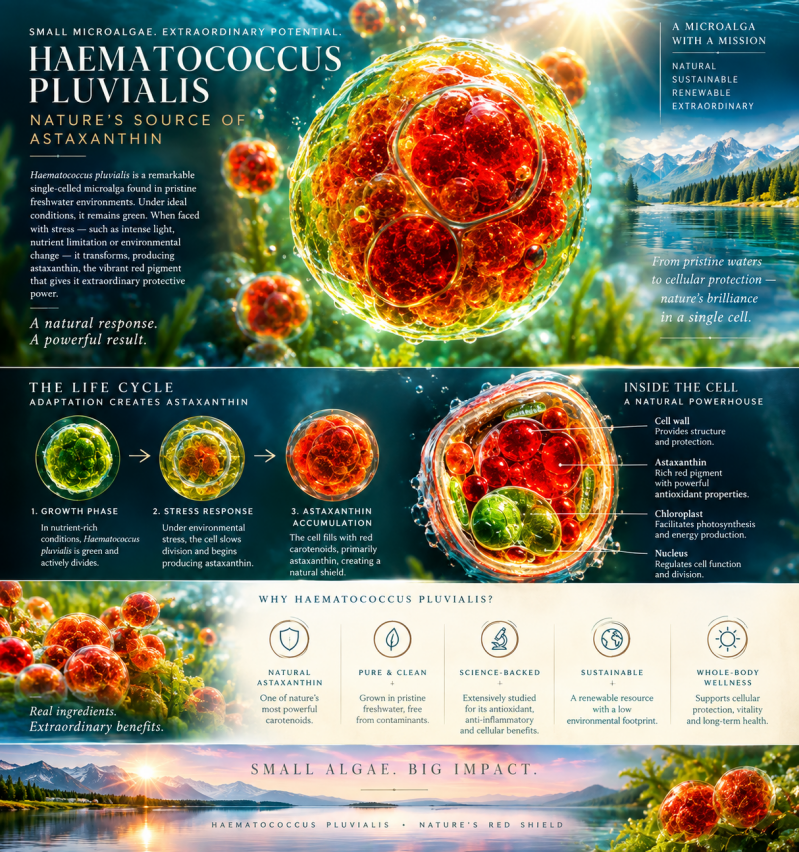
Astaxanthin is produced naturally by certain microalgae, particularly Haematococcus pluvialis, and subsequently becomes concentrated in aquatic organisms that consume these microorganisms. It is responsible for much of the characteristic red coloration of salmon, trout, shrimp, krill and certain other marine organisms.
But its remarkable color is only the visible expression of something far more consequential:
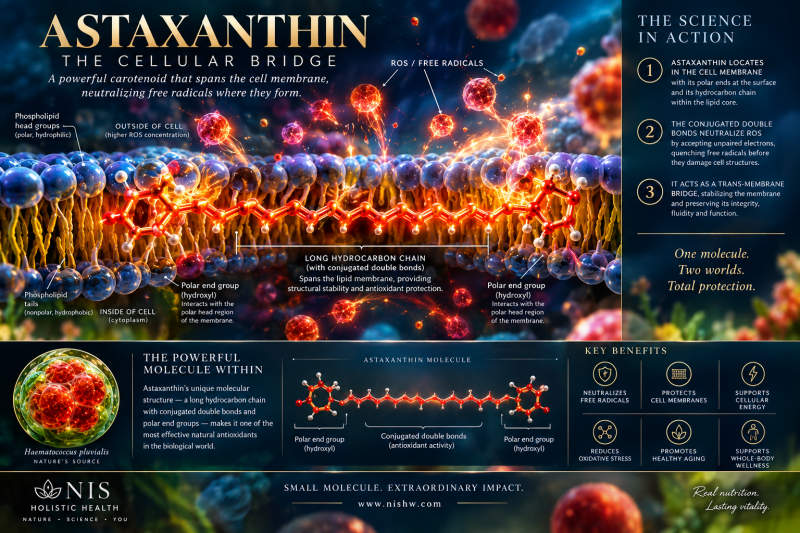
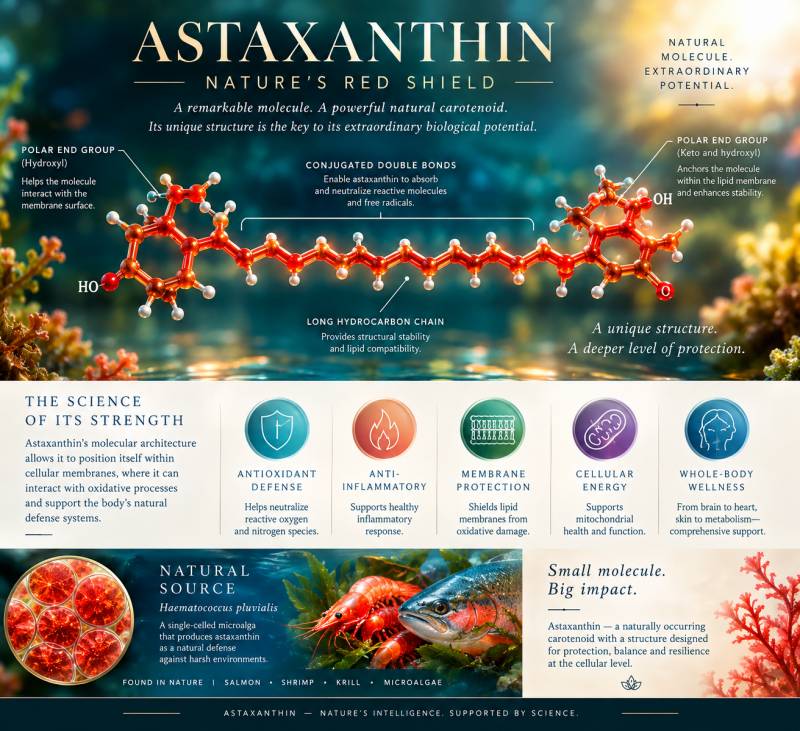
Astaxanthin possesses a molecular structure extraordinarily well suited to the environment of the cell membrane.
Its long central hydrocarbon chain is flanked by polar end groups. This gives the molecule an unusual ability to orient itself within lipid membranes, placing its antioxidant activity precisely where oxidative damage can become particularly consequential.
Recent molecular research continues to support this membrane-oriented behavior, showing that astaxanthin can position itself within phospholipid membranes and interact with different regions of the membrane environment.
This distinction is fundamental.
Astaxanthin is not simply another antioxidant circulating through the bloodstream.
It is a membrane-associated antioxidant.
And that may be one of the most important reasons for its extraordinary biological interest.
THE OXIDATIVE STRESS PROBLEM
Every living cell exists in a delicate biochemical environment.
Oxygen is indispensable to life, yet normal oxygen metabolism inevitably produces reactive oxygen species, or ROS.
These molecules are not inherently harmful.
In fact, controlled amounts of reactive oxygen species participate in normal cellular signaling, immune defense, adaptation to exercise and other physiological processes.
The problem arises when production overwhelms the body's capacity to regulate and neutralize them.
This condition is commonly described as oxidative stress.
Excessive oxidative stress can affect:
- cellular membranes
- lipids
- proteins
- DNA
- mitochondria
- endothelial function
- cellular signaling
- inflammatory pathways
- neurological tissues
The objective of sophisticated antioxidant biology therefore should not be to eliminate every reactive oxygen species.
That would be neither possible nor desirable.
The objective is redox balance.
The body needs enough oxidative signaling to communicate and adapt—but not so much oxidative pressure that cellular structures become damaged.
Astaxanthin is particularly interesting because its activity appears to extend beyond simple radical scavenging.
It can directly interact with reactive molecules while also influencing endogenous antioxidant systems and inflammatory signaling pathways.
Human clinical research increasingly supports this broader biological model. A 2026 systematic review of 15 human studies reported reductions in several oxidative-stress and inflammatory measures alongside increases in antioxidant capacity, although the authors emphasized the need for larger, better-designed clinical trials.
WHY 🔴 ASTAXANTHIN 🛡 IS DIFFERENT
Astaxanthin's extraordinary reputation begins with its chemistry.
Unlike some antioxidants that operate primarily within either water-based or lipid-based environments, astaxanthin has structural characteristics that allow it to interact with the lipid membrane while maintaining polar regions near the membrane surfaces.
Think of the cellular membrane as a vast biological boundary.
It is composed largely of lipids.
And those lipids are vulnerable to oxidation.
When lipid peroxidation begins, a chain reaction can develop in which one oxidized lipid contributes to the oxidation of neighboring lipids.
Astaxanthin's positioning within the membrane gives it an opportunity to intercept reactive species and help interrupt oxidative chain reactions.
This is one reason astaxanthin has attracted particular interest compared with many conventional antioxidants.
Its molecular architecture enables it to operate within the membrane environment itself.
THE "NO PRO-OXIDANT" QUESTION
Astaxanthin is frequently described as an antioxidant that does not readily become a damaging pro-oxidant after neutralizing reactive species.
This characteristic has been proposed as one of its important advantages.
A review specifically examining astaxanthin's antioxidant behavior described its ability to neutralize oxidants through electron donation or acceptance without readily becoming a pro-oxidant itself.
However, scientific precision matters.
It would be inaccurate to claim that no antioxidant molecule can ever exhibit pro-oxidant behavior under any experimental condition.
Antioxidant behavior can depend upon:
- concentration
- oxygen tension
- cellular environment
- metal availability
- molecular form
- oxidation state
- light exposure
- temperature
- formulation
- biological compartment
Astaxanthin's remarkable reputation therefore is better expressed this way:
«Astaxanthin demonstrates exceptionally strong antioxidant behavior and, at commonly studied supplemental exposures, has not demonstrated the concerning pro-oxidant profile associated with some antioxidant compounds under particular experimental conditions.»
That is a much more scientifically responsible statement—and arguably a more compelling one.
🔴 ASTAXANTHIN 🛡 AND FREE-RADICAL DEFENSE
Astaxanthin can interact with several classes of reactive molecules.
Research has described activity involving:
- singlet oxygen
- peroxyl radicals
- hydroxyl radicals
- reactive oxygen species
- reactive nitrogen species
Its antioxidant activity also appears to involve more than direct scavenging.
Astaxanthin may influence the body's own antioxidant machinery.
This distinction is crucial.
The most sophisticated antioxidant strategy is not necessarily to supply an external molecule that simply "mops up" free radicals.
It is to support the organism's own redox defense network.
Astaxanthin has been investigated for its influence on endogenous antioxidant systems including:
Superoxide dismutase (SOD)
Glutathione-related defenses
Catalase
Total antioxidant capacity
and other cellular defense mechanisms.
A recent human systematic review reported increases in antioxidant capacity and SOD-related measures across several studies.
THE Nrf2 CONNECTION
One of the most fascinating areas of astaxanthin research involves Nrf2.
Nuclear factor erythroid 2–related factor 2, commonly abbreviated Nrf2, is a major regulator of cellular antioxidant and cytoprotective responses.
When appropriately activated, Nrf2 influences the expression of numerous genes involved in cellular defense, detoxification and antioxidant protection.
Astaxanthin has been investigated for its ability to influence this pathway.
This creates an important conceptual distinction:
Astaxanthin may not merely neutralize oxidative molecules—it may also help influence the cellular machinery responsible for defending against oxidative stress.
That is one reason researchers increasingly view astaxanthin as a biologically active signaling molecule rather than merely a passive antioxidant.
Research has identified interactions involving Nrf2 alongside NF-κB and several MAPK signaling pathways.
🔴 ASTAXANTHIN 🛡 AND INFLAMMATION
Oxidative stress and inflammation are deeply interconnected.
Excessive oxidative stress can activate inflammatory signaling.
Inflammatory activity can, in turn, increase oxidative stress.
This creates a potentially self-reinforcing cycle:
Oxidative stress → cellular signaling → inflammatory activation → additional oxidative stress
Astaxanthin appears capable of influencing several components of this cycle.
Among the most frequently investigated inflammatory pathways are:
- NF-κB
- MAPK
- JAK/STAT
- Nrf2
- PI3K/AKT
NF-κB is particularly important because it regulates the expression of numerous inflammatory mediators.
Research suggests that astaxanthin can modulate NF-κB signaling, thereby potentially reducing the expression of certain inflammatory cytokines and mediators.
A NATURAL INFLAMMATION MODULATOR
Astaxanthin should not be thought of simply as an "anti-inflammatory pill."
A more biologically meaningful perspective is that it may help modulate excessive inflammatory signaling.
Human research has investigated effects on inflammatory biomarkers including:
- IL-6
- TNF-α
- CRP
- TGF-β1
Results have varied between studies.
A 2022 systematic review and meta-analysis involving 12 randomized controlled trials and 380 participants found significant reductions in malondialdehyde, a marker of lipid oxidation, while effects on inflammatory biomarkers were more selective; IL-6 was reduced in participants with type 2 diabetes, whereas CRP and TNF-α were not significantly changed overall.
More recent human research has reported broader reductions in inflammatory cytokines, but the authors continue to emphasize heterogeneity and the need for additional high-quality clinical trials.
This is precisely why astaxanthin is so interesting:
The biological signal is strong enough to warrant serious investigation, while the clinical evidence continues to mature.
THE MEMBRANE:
🔴 ASTAXANTHIN'S 🛡 BIOLOGICAL HOME
Perhaps the most elegant feature of astaxanthin is its relationship with the cell membrane.
Cell membranes are not inert barriers.
They are dynamic biological interfaces responsible for:
- communication
- transport
- receptor activity
- electrical gradients
- nutrient exchange
- cellular recognition
- signal transduction
The lipid components of these membranes are vulnerable to oxidation.
Astaxanthin's structure allows it to integrate into this lipid environment.
Imagine placing a molecular shield across the very territory where oxidative attack can begin.
That is essentially the biological concept that makes astaxanthin so intriguing.
Its polar ends can interact toward membrane surfaces while its central nonpolar region occupies the lipid interior.
Recent molecular studies have provided additional evidence that astaxanthin is particularly well positioned within phospholipid membranes to exert antioxidant activity.
CARDIOVASCULAR RESILIENCE
The cardiovascular system is particularly vulnerable to oxidative stress and chronic inflammatory signaling.
Blood vessels depend upon healthy endothelial function.
The endothelium is the thin cellular lining of the vascular system that participates in:
- vascular tone
- blood flow regulation
- platelet interactions
- inflammatory signaling
- vascular permeability
Astaxanthin has therefore attracted considerable cardiovascular research interest.
Investigations have examined potential effects involving:
- oxidative stress
- endothelial function
- lipid metabolism
- vascular inflammation
- arterial stiffness
- blood-flow regulation
Reviews describe potentially beneficial effects on cardiovascular oxidative and inflammatory pathways, although clinical outcomes remain less established than mechanistic evidence.
The appropriate conclusion is therefore not that astaxanthin "prevents heart disease."
Rather:
Astaxanthin represents a promising nutritional compound for supporting the biological systems involved in cardiovascular resilience.
BRAIN AND NEUROLOGICAL PROTECTION
The brain is metabolically extraordinary.
It consumes enormous amounts of energy and oxygen while possessing a high concentration of vulnerable lipids.
This makes neurological tissue particularly sensitive to oxidative stress.
Astaxanthin has generated substantial interest in neurological research because of its antioxidant and anti-inflammatory properties and its ability to reach the central nervous system.
Research has investigated potential effects involving:
- neuroinflammation
- oxidative stress
- mitochondrial function
- blood-brain barrier integrity
- neuronal survival
- cognitive function
- neurological aging
Reviews have described potential neuroprotective effects, although much of the evidence remains preclinical and human neurological outcome data remain comparatively limited.
This distinction matters.
Astaxanthin should not be marketed as a treatment for Alzheimer's disease, Parkinson's disease, stroke or other neurological disorders.
But its ability to influence oxidative and inflammatory pathways relevant to neurological health makes it an important area of ongoing investigation.
EYES AND VISUAL HEALTH
The eye is another tissue in which oxidative stress is highly relevant.
The retina is metabolically active and continuously exposed to light.
Astaxanthin has therefore attracted interest in visual physiology and ocular health.
Clinical studies have investigated areas such as:
- visual fatigue
- accommodation
- ocular circulation
- visual performance
- oxidative protection
Earlier randomized trials reported improvements in certain visual and accommodative measures, although the overall evidence remains insufficient to claim prevention or treatment of eye disease.
Its potential importance again comes back to the same theme: oxidative balance + inflammation control + membrane protection.
SKIN: PROTECTION FROM THE INSIDE OUT
Skin is constantly exposed to environmental stressors.
Among them:
- ultraviolet radiation
- pollution
- oxidative stress
- inflammation
- dehydration
- metabolic stress
Astaxanthin has consequently been studied for its potential photoprotective and skin-supportive properties.
Clinical research has examined outcomes including:
- skin moisture
- elasticity
- wrinkle formation
- oxidative stress
- skin barrier characteristics
A systematic review of clinical studies concluded that astaxanthin shows potential for improving several aspects of skin health, while also noting the limitations of the available evidence.
This makes astaxanthin particularly interesting within a broader concept of healthy aging.
MITOCHONDRIAL SUPPORT
Mitochondria are the energy-producing organelles of the cell.
They generate ATP—the fundamental energy currency used by virtually every cellular process.
But mitochondrial energy production inevitably involves oxygen chemistry.
Consequently, mitochondria are both:
producers of energy
and
sources of reactive oxygen species.
This makes mitochondrial redox regulation critically important.
Preclinical research suggests that astaxanthin may help protect mitochondrial structures against oxidative stress and preserve mitochondrial redox balance.
The implication is compelling:
Protecting the membrane may help protect the machinery responsible for producing cellular energy.
However, robust human evidence demonstrating meaningful improvements in mitochondrial function remains an area for further investigation.
EXERCISE AND RECOVERY
Exercise is one of the most powerful forms of biological stress.
And that is exactly why it can be beneficial.
Exercise temporarily increases oxidative stress and inflammatory signaling, which can stimulate adaptation.
Again, the goal is not to eliminate oxidative signaling.
The goal is appropriate recovery and redox balance.
Astaxanthin has therefore been studied in athletes and physically active individuals.
A 2026 meta-analysis of seven randomized trials involving 188 participants found that astaxanthin reduced advanced oxidation protein products, although other oxidative and exercise-injury biomarkers did not consistently improve. The investigators concluded that more standardized trials are needed.
This is an important lesson:
A powerful antioxidant is not automatically a performance enhancer.
Astaxanthin may support certain aspects of oxidative balance during physical stress, but claims of dramatically increased endurance or athletic performance remain insufficiently established.
METABOLIC HEALTH
Astaxanthin has also been investigated in relation to metabolic physiology.
Researchers have examined potential effects involving:
- glucose regulation
- insulin sensitivity
- triglycerides
- HDL cholesterol
- lipid oxidation
- adipose inflammation
- oxidative stress
Recent human studies summarized in a 2026 systematic review reported improvements in some metabolic parameters, particularly when astaxanthin supplementation was combined with exercise.
Nevertheless, astaxanthin should be viewed as a potential adjunct to healthy metabolic living, not as a substitute for nutrition, exercise, sleep, hydration or appropriate medical care.
IMMUNE SYSTEM BALANCE
The immune system is another area where redox biology matters.
Immune cells intentionally generate reactive oxygen species as part of normal host defense.
But excessive oxidative stress can also contribute to tissue injury and dysregulated inflammatory signaling.
Astaxanthin has demonstrated immunomodulatory properties in experimental research and has been investigated in human studies.
The objective is not to "boost immunity" indiscriminately.
A better concept is:
SUPPORTING IMMUNE HOMEOSTASIS
A healthy immune system requires both activation and restraint.
It must recognize threats without remaining unnecessarily activated after the threat has passed.
Astaxanthin's antioxidant and inflammatory-signaling effects make this balance an important area of research.
🔴 ASTAXANTHIN 🛡 AND HEALTHY AGING
Aging is not caused by one biological mechanism.
It is a complex interaction among:
- oxidative stress
- inflammation
- mitochondrial changes
- cellular senescence
- altered metabolic signaling
- DNA damage
- declining physiological reserve
- environmental exposure
Astaxanthin does not "stop aging."
But it intersects with several biological pathways associated with healthy aging.
That is why researchers have investigated it as a potential healthy-aging nutraceutical.
Its appeal lies in the convergence of multiple actions:
Antioxidant activity
Membrane protection
Inflammatory modulation
Mitochondrial support
Neuroprotective potential
Cardiovascular support
Skin protection
Metabolic regulation
This multi-target nature is one of the most intriguing characteristics of astaxanthin.
THE BEAUTY OF REDOX BALANCE
Perhaps the deepest lesson astaxanthin teaches us is that biology rarely operates in simple categories.
"Oxidants are bad."
"Antioxidants are good."
That is too simplistic.
Reactive oxygen species participate in normal cellular communication.
Inflammation is essential to healing.
Oxidative signaling can stimulate adaptation.
The objective is not biological silence.
It is biological balance.
Astaxanthin is compelling because its actions appear to operate at several levels simultaneously:
1. DIRECT ANTIOXIDANT ACTION
It can interact with reactive oxygen and nitrogen species.
2. MEMBRANE PROTECTION
It can position itself within lipid membranes where oxidative damage can become particularly consequential.
3. ENDOGENOUS DEFENSE
It may influence cellular antioxidant systems such as Nrf2-associated defenses.
4. INFLAMMATORY MODULATION
It can influence signaling pathways associated with inflammatory mediator production.
5. CELLULAR PROTECTION
It has demonstrated cytoprotective and anti-apoptotic effects in experimental systems.
6. SYSTEMIC RESILIENCE
Its combined effects are being investigated across cardiovascular, neurological, metabolic, ocular and dermatological physiology.
NATURAL 🔴 ASTAXANTHIN 🛡: SOURCE MATTERS
Not all astaxanthin products are identical.
Natural astaxanthin is commonly derived from the microalga:
Haematococcus pluvialis
Other sources and synthetic forms also exist.
The molecular form, stereochemistry, formulation, stability and delivery system can influence bioavailability and biological behavior.
Astaxanthin is sensitive to environmental conditions including light, heat and oxygen, making formulation and storage important considerations.
For individuals considering supplementation, product quality and provenance therefore matter.
ABSORPTION AND BIOAVAILABILITY
Astaxanthin is fat-soluble.
Consequently, its absorption is influenced by the presence of dietary fat and by the formulation in which it is delivered.
Its bioavailability can also vary according to:
- formulation
- particle size
- esterification
- delivery system
- food composition
- individual physiology
This is one reason why two products containing the same nominal milligram quantity may not necessarily produce identical physiological exposure.
HOW MUCH?
There is no universally established optimal dose for every person or purpose.
Human research has investigated a broad range of doses.
A safety review examining 87 human studies reported no safety concerns attributable to natural astaxanthin supplementation in the reviewed studies, including studies using doses of 12 mg/day or greater, while also noting differences in regulatory recommendations and distinctions between natural and synthetic forms.
A randomized clinical trial involving healthy adults found that 6 mg/day from a Haematococcus pluvialis extract was well tolerated over eight weeks.
Importantly, more is not automatically better.
The appropriate dose depends upon the individual, the product, the purpose of supplementation and the broader health context.
🔴 ASTAXANTHIN 🛡 IS NOT A MIRACLE MOLECULE
The science surrounding astaxanthin is exciting.
But responsible holistic healthcare requires intellectual honesty.
Astaxanthin should not be represented as a cure for:
- cardiovascular disease
- cancer
- Alzheimer's disease
- Parkinson's disease
- diabetes
- autoimmune disease
- infections
- inflammatory disorders
- neurological disorders
Nor should supplementation be represented as a replacement for appropriate medical diagnosis or treatment.
The strongest scientific position is more nuanced:
Astaxanthin is a biologically active carotenoid with unusually strong antioxidant and anti-inflammatory potential, supported by substantial mechanistic research and a growing, but still incomplete, body of human clinical evidence.
That statement is powerful precisely because it does not need exaggeration.
THE LARGER HOLISTIC PERSPECTIVE
No single nutrient can compensate for a chronically stressed biological environment.
Astaxanthin should therefore be considered within the larger architecture of health:
adequate hydration
nutrient-dense food
healthy movement
strength and cardiovascular conditioning
restorative sleep
breathing
sunlight and appropriate environmental exposure
stress regulation
healthy relationships
minimizing unnecessary toxic exposures
and maintaining physiological adaptability
Astaxanthin can be viewed as one component within this larger biological picture.
The objective is not to overwhelm the body with supplements.
The objective is to create an environment in which the body's own regulatory systems have the resources necessary to function optimally.
THE RED MOLECULE 🔴 WITH A REMARKABLE MISSION
Astaxanthin's story is ultimately a story about protection.
Protection against excessive oxidation.
Protection of vulnerable lipid membranes.
Protection of cellular structures.
Potential support for mitochondrial integrity.
Modulation of inflammatory signaling.
Support for endogenous antioxidant defenses.
Potential protection of neurological and ocular tissues.
Potential cardiovascular and metabolic support.
And perhaps most importantly, support for the biological principle upon which health ultimately depends:
HOMEOSTASIS
The human organism is constantly negotiating between stress and recovery, oxidation and reduction, activation and restraint, breakdown and repair.
Astaxanthin does not replace those processes.
It may help support them.
And that is what makes this molecule so fascinating.
THE FINAL PERSPECTIVE
In the world of nutritional science, antioxidants are often discussed as though they were interchangeable.
They are not.
Their chemistry matters.
Their location matters.
Their ability to interact with biological membranes matters.
Their relationship with cellular signaling matters.
And their ability to participate in the body's own antioxidant defense systems matters.
Astaxanthin stands apart because of the remarkable convergence of these characteristics.
It is a naturally occurring xanthophyll carotenoid with an unusual molecular architecture, extraordinary free-radical-scavenging capacity, strong membrane affinity, significant anti-inflammatory potential and growing evidence for broader biological effects.
Its greatest promise may not come from one isolated benefit.
It may come from the convergence of multiple protective actions occurring simultaneously within the biological terrain of the cell.
That is the deeper significance of astaxanthin.
Not merely an antioxidant.
Not merely an anti-inflammatory compound.
Not merely a carotenoid.
But a fascinating example of how a naturally occurring molecule can interact with the fundamental chemistry of life.
🔴 ASTAXANTHIN 🛡
A molecular shield at the membrane.
A regulator of oxidative balance.
A potential modulator of inflammation.
A supporter of cellular resilience.
"And, perhaps most compellingly, a reminder that the most sophisticated form of holistic health is not about forcing the body to do something unnatural—but about supporting the biological intelligence already working continuously within it."
🔴🛡
🔴🛡