“A microscopic grain carrying a universe of nutrition.”
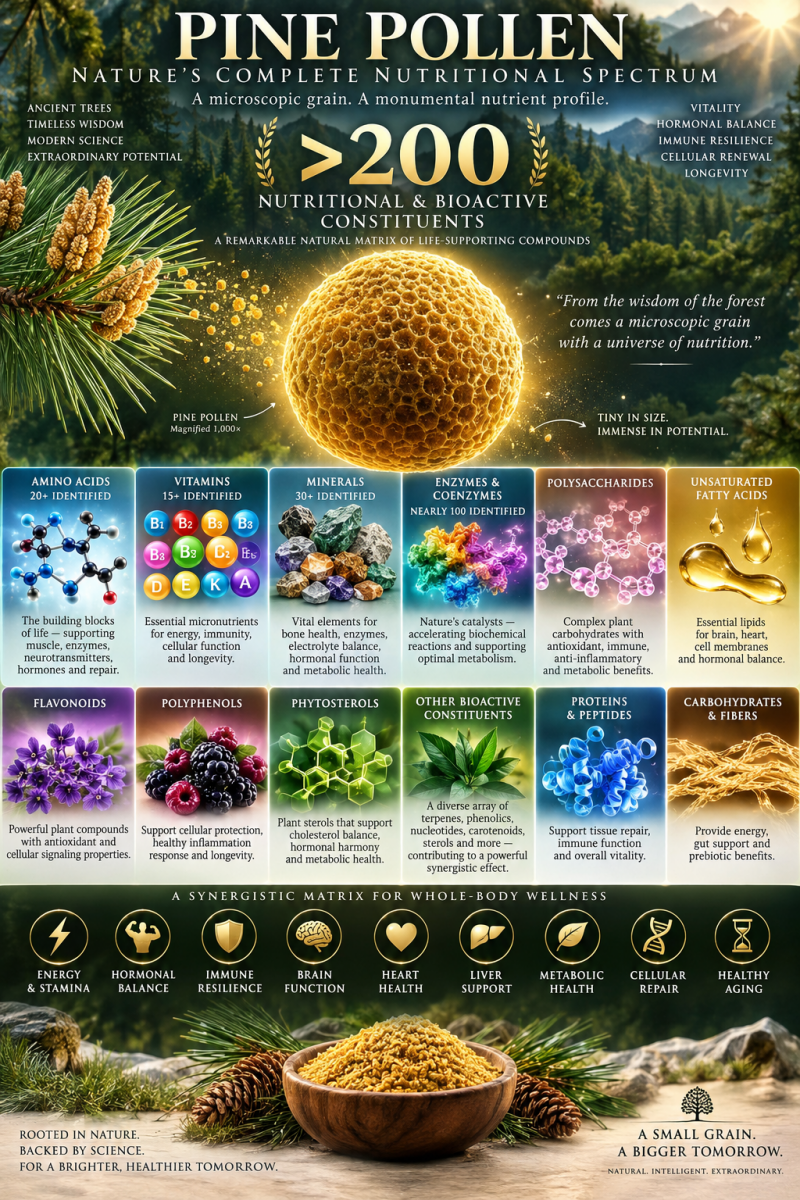
PINE POLLEN
The Botanical Blueprint of Vitality, Nutritional Resilience & Healthy Aging
More than 200 nutritional and bioactive constituents in a microscopic biological package
There are substances in nature that seem almost deliberately designed to remind us how extraordinarily intelligent biological systems can be.
Pine pollen is one of them.
Before a pine tree can reproduce, it must package an extraordinary amount of biological information and biochemical machinery into something almost weightless: a microscopic grain capable of surviving environmental stress, traveling through the air, and delivering its reproductive payload.
That tiny grain is pine pollen.
And within that microscopic structure exists an astonishing biochemical spectrum.
Modern research describes pine pollen as a nutrient-rich botanical matrix containing more than 200 varieties of nutritional and bioactive constituents, including proteins, amino acids, vitamins, minerals, enzymes and coenzymes, carbohydrates, lipids, unsaturated fatty acids, flavonoids, phytosterols, polyphenols, polysaccharides and other biologically active compounds.
This is what makes pine pollen so intriguing.
It is not simply one active molecule.
It is not merely a source of protein.
It is not simply an antioxidant.
It is a multidimensional biochemical matrix.
And the deeper science looks, the more extraordinary that matrix becomes.
MORE THAN 200 BIOACTIVE & NUTRITIONAL CONSTITUENTS
Imagine attempting to design a nutritional formula containing more than two hundred different naturally occurring nutritional and bioactive constituents.
You would need to consider:
Amino acids.
Proteins.
Vitamins.
Minerals.
Enzymes.
Coenzymes.
Polysaccharides.
Lipids.
Unsaturated fatty acids.
Flavonoids.
Polyphenols.
Phytosterols.
Other phytochemicals and specialized plant metabolites.
Nature does not manufacture pine pollen in a laboratory.
It creates it through the extraordinary biochemical intelligence of the pine tree.
A 2024 review describes pine pollen as containing over 20 amino acids, approximately 15 vitamins, more than 30 minerals, nearly 100 enzymes and coenzymes, unsaturated fatty acids, flavonoids and other active substances, collectively described as totaling more than 200 varieties of constituents.
The precise composition, however, can vary substantially according to pine species, geographic origin, climate, altitude, soil conditions, harvesting and processing.
That variability is not a weakness.
It is a reminder that pine pollen is a biological food rather than a single chemically standardized molecule.
A BIOCHEMICAL SYMPHONY
Perhaps the best way to understand pine pollen is to stop thinking of it as a supplement and begin thinking of it as a biochemical symphony.
One molecule does not create the music.
The orchestra does.
Likewise, pine pollen's nutritional significance does not rest upon a single constituent.
Its fascination emerges from the interaction of a remarkably diverse collection of compounds.
AMINO ACIDS
The raw materials of proteins, enzymes, neurotransmitter pathways and countless metabolic reactions.
VITAMINS
Micronutrients required for enzymatic reactions, cellular metabolism, antioxidant defense and physiological regulation.
MINERALS
Essential elements serving as cofactors and structural components throughout the organism.
ENZYMES & COENZYMES
Molecular participants in biochemical reactions essential to life.
POLYSACCHARIDES
Complex carbohydrates with emerging research interest involving antioxidant, immune, inflammatory and metabolic pathways.
UNSATURATED FATTY ACIDS
Lipids with important nutritional roles in cellular membranes and metabolic physiology.
FLAVONOIDS & POLYPHENOLS
Plant-derived compounds extensively investigated for antioxidant and cellular signaling properties.
PHYTOSTEROLS
Plant sterol compounds structurally related to cholesterol and increasingly studied for their nutritional and metabolic significance.
Together, these constituents transform pine pollen from an interesting botanical curiosity into a remarkably sophisticated nutritional matrix.
THE MICRO-NUTRIENT BANK OF THE FOREST
The term "natural micronutrient bank" has been used in the scientific literature to describe pine pollen because of its diverse nutritional composition.
And the metaphor is compelling.
A pine tree gathers resources from its environment:
Sunlight.
Water.
Minerals.
Carbon dioxide.
Atmospheric elements.
Through photosynthesis and an extraordinary network of biochemical reactions, those raw materials are transformed into living tissue.
Eventually, the tree produces pollen.
Within that microscopic reproductive structure lies a remarkably concentrated collection of biological materials.
It is almost as if the tree has created a microscopic nutritional archive.
THE AMINO ACID DIMENSION
Among the most fundamental constituents are amino acids.
Amino acids are not simply "muscle building blocks."
They participate throughout human physiology.
They contribute to:
- Protein synthesis
- Enzyme formation
- Neurotransmitter pathways
- Tissue maintenance
- Immune function
- Hormonal signaling
- Nitrogen metabolism
- Cellular repair
- Energy metabolism
Research has identified numerous amino acids in pine pollen, including essential amino acids.
The significance is not that pine pollen replaces dietary protein.
It does not.
The significance is that the pollen grain contains amino acids within a much larger constellation of nutritional compounds.
THE VITAMIN & MINERAL MATRIX
Pine pollen also contains vitamins and minerals, with research reporting a broad spectrum of micronutrients.
Minerals participate in:
Electrolyte balance.
Neuromuscular function.
Enzymatic reactions.
Bone metabolism.
Cellular signaling.
Energy metabolism.
Antioxidant defense.
Vitamins likewise participate in hundreds of biochemical reactions.
Yet the exact nutritional contribution depends on the species and product.
That is why responsible interpretation requires distinguishing between:
presence of a nutrient
and
clinically meaningful nutritional dosage.
The two are not automatically synonymous.
NEARLY 100 ENZYMES & COENZYMES
One of the most fascinating descriptions in the literature is the reported presence of nearly 100 enzymes and coenzymes within pine pollen.
This adds another dimension to the pollen story.
Enzymes are among nature's most sophisticated catalysts.
They accelerate and regulate biochemical reactions that would otherwise occur too slowly to sustain life.
However, an important scientific distinction must be made:
The presence of an enzyme in a food does not mean that the intact enzyme will survive digestion and function as an enzyme inside human tissues.
Rather, this finding contributes to our understanding of the biochemical complexity of pine pollen itself.
And that complexity is extraordinary.
THE POLYSACCHARIDE POWERHOUSE
Pine-pollen polysaccharides have become one of the most intensively investigated fractions of the pollen.
A 2024 review describes multiple experimental activities associated with pine-pollen polysaccharides, including antioxidant, anti-inflammatory, immunomodulatory, hypoglycemic, lipid-regulating, hepatoprotective, antibacterial and antiviral activities.
This is one of the most exciting areas of current research.
But again, scientific discipline matters.
Much of this evidence comes from cellular, biochemical or animal models.
These findings provide mechanisms worthy of investigation.
They do not establish that consuming pine pollen produces the same therapeutic effects in humans.
That distinction protects the integrity of the science—and actually makes the story more credible.
FLAVONOIDS & POLYPHENOLS
Flavonoids and other polyphenols are among the most celebrated classes of plant phytochemicals.
Their significance lies partly in their ability to interact with oxidative and cellular signaling pathways.
Pine pollen contains flavonoid and phenolic constituents, and experimental research has demonstrated antioxidant activity in pine-pollen extracts.
This places pine pollen within a much broader botanical world of phytochemical research.
The extraordinary point is not that pine pollen contains antioxidants.
Thousands of plants do.
The fascinating point is the diversity of antioxidant-related compounds existing alongside proteins, amino acids, minerals, polysaccharides, lipids and other constituents in the same biological matrix.
THE PHYTOSTEROL CONNECTION
Phytosterols are plant-derived sterol compounds structurally related to cholesterol.
They are another fascinating component of pine pollen's biochemical profile.
The presence of phytosterols adds another layer to the pollen's nutritional complexity and contributes to the growing scientific interest in pine pollen's potential relationship with lipid metabolism.
Again, the correct interpretation is not that pine pollen "lowers cholesterol."
Rather:
pine pollen contains phytosterols and other compounds that have generated research interest surrounding lipid metabolism.
THE HORMONAL DIMENSION
And then we arrive at perhaps the most intriguing—and most misunderstood—aspect of pine pollen.
Hormonal biology.
Some pine pollen preparations have been reported to contain steroid-related compounds, including testosterone.
This has generated enormous interest in pine pollen as a natural approach to male vitality.
But the scientific question is considerably more sophisticated than:
«"Does pine pollen contain testosterone?"»
The real question is:
Does consuming pine pollen produce a clinically meaningful alteration in human endocrine physiology?
That question remains incompletely answered.
The presence of a hormone or steroid-related molecule within a plant does not automatically mean that oral consumption produces a significant increase in circulating hormone concentrations.
Absorption, metabolism, dosage, bioavailability and individual physiology all matter.
Therefore, pine pollen should be described as hormonally intriguing rather than a proven testosterone therapy.
VITALITY IS AN ORCHESTRA
This distinction reveals something important.
Vitality is not a hormone.
Vitality is not an antioxidant.
Vitality is not an amino acid.
Vitality is the orchestration of hundreds of biological processes.
Energy production.
Neurological signaling.
Hormonal communication.
Immune surveillance.
Muscular function.
Nutrient utilization.
Recovery.
Sleep.
Metabolic flexibility.
Cellular maintenance.
Pine pollen is fascinating precisely because its chemistry touches so many of these biological dimensions simultaneously.
OXIDATIVE BALANCE
The body exists within a continuous relationship between oxidation and antioxidant defense.
Reactive oxygen species are generated naturally through metabolism and cellular signaling.
They are not inherently "bad."
They become problematic when production and protective mechanisms become chronically imbalanced.
Pine pollen's polyphenols, flavonoids and other phytochemicals have demonstrated antioxidant activity in experimental studies.
This makes pine pollen an intriguing subject in the broader study of cellular resilience.
INFLAMMATORY BALANCE
Inflammation is another area where the complexity of pine pollen becomes particularly interesting.
Research involving pine-pollen polysaccharides and extracts has identified anti-inflammatory activity in experimental models.
But rather than viewing inflammation as an enemy to be eliminated, a more sophisticated biological perspective recognizes that inflammation is a tightly regulated physiological process.
The goal is not simply:
"less inflammation."
The goal is:
appropriate inflammatory signaling, appropriate resolution and restoration of biological balance.
IMMUNE INTELLIGENCE
The immune system is a communication network of extraordinary complexity.
Pine-pollen polysaccharides have demonstrated immunomodulatory activity in experimental research.
The word modulatory is important.
The objective of a healthy immune system is not maximum activation.
It is appropriate response.
Pine pollen therefore becomes interesting not because it is a simplistic "immune booster," but because its constituents may interact with biological signaling pathways involved in immune regulation.
METABOLIC RESILIENCE
Pine pollen research also extends into glucose and lipid metabolism.
Experimental studies have investigated its potential influence on:
Glucose regulation.
Lipid metabolism.
Oxidative stress.
Liver function.
Energy metabolism.
These findings remain an area of active research rather than proof of therapeutic efficacy in humans.
But the convergence is remarkable.
A botanical matrix containing hundreds of constituents is being investigated across multiple dimensions of metabolism.
THE LONGEVITY QUESTION
Perhaps the most captivating question is:
Could the biochemical diversity of pine pollen contribute to healthy aging?
Research has investigated pine pollen in relation to antioxidant defense, inflammation, metabolism, immune regulation, liver biology and other processes relevant to aging.
But longevity is not created by one supplement.
Healthy aging emerges from the interaction of:
Genetics.
Nutrition.
Movement.
Sleep.
Metabolic health.
Stress regulation.
Environmental exposure.
Social connection.
Recovery.
And countless biological processes.
Pine pollen may eventually prove to have meaningful applications within this larger picture.
Science has not yet earned the right to say more.
THE EXTRAORDINARY CONVERGENCE
This is what makes the pine-pollen story so compelling.
Within one microscopic botanical structure we find an extraordinary convergence of:
20+ AMINO ACIDS
Building blocks and metabolic substrates.
15+ VITAMINS
Micronutrients participating in essential biochemical processes.
30+ MINERALS
Cofactors and structural elements.
NEARLY 100 ENZYMES & COENZYMES
Components of the pollen's own biochemical machinery.
POLYSACCHARIDES
Complex carbohydrates under intensive investigation for biological activity.
UNSATURATED FATTY ACIDS
Important nutritional lipids.
FLAVONOIDS
Plant phytochemicals with antioxidant and signaling properties.
POLYPHENOLS
A broad family of bioactive plant compounds.
PHYTOSTEROLS
Plant sterols relevant to nutritional and metabolic research.
OTHER BIOACTIVE CONSTITUENTS
Additional specialized plant compounds contributing to the overall chemical complexity.
More than 200 varieties of nutritional and bioactive constituents.
Not one.
Not ten.
Not merely a handful.
Hundreds.
That is the biochemical story worth telling.
A FOREST IN A GRAIN
A mature pine tree can stand for decades.
Its roots penetrate the earth.
Its needles intercept sunlight.
Its vascular system transports water and nutrients.
Its tissues continuously synthesize, transform and recycle molecules.
And eventually, from all of this biological complexity, the tree produces something almost impossibly small.
A grain of pollen.
Within that microscopic structure lies an extraordinary collection of nutrients and phytochemicals.
It is a reminder that biological sophistication is not proportional to physical size.
The smallest biological packages can contain astonishing complexity.
THE HOLISTIC PERSPECTIVE
Perhaps the greatest lesson of pine pollen is not that one substance can "do everything."
It cannot.
The deeper lesson is that biology itself is multidimensional.
One pathway rarely exists independently.
One nutrient rarely operates in isolation.
One system rarely functions without communication with another.
The nervous system communicates with the endocrine system.
The endocrine system communicates with metabolism.
The immune system communicates with tissues.
The gastrointestinal system communicates with the brain.
The liver communicates with virtually every aspect of systemic physiology.
And nutrition supplies the molecular raw materials from which these systems operate.
Pine pollen is therefore best appreciated as a complex botanical nutritional matrix, not as a magic bullet.
THE FINAL PERSPECTIVE
Pine pollen is extraordinary precisely because it does not need exaggerated claims.
Its natural complexity is enough.
A single microscopic pollen grain represents the culmination of an elaborate botanical process.
And within pine pollen exists a remarkably diverse collection of nutritional and bioactive constituents—more than 200 reported varieties across multiple chemical classes, depending upon species, origin and analytical method.
Proteins.
Amino acids.
Vitamins.
Minerals.
Enzymes.
Coenzymes.
Polysaccharides.
Lipids.
Unsaturated fatty acids.
Flavonoids.
Polyphenols.
Phytosterols.
And numerous other plant-derived compounds.
Together they create something far more interesting than a simple supplement.
They create a biochemical ecosystem in miniature.
And perhaps that is the most awe-inspiring way to look at pine pollen:
Not as a miracle.
Not as a pharmaceutical.
Not as a promise.
But as an extraordinary expression of biological intelligence.
A microscopic grain.
Hundreds of nutritional and bioactive constituents.
Thousands of years of botanical evolution.
And an emerging scientific story about vitality, resilience and healthy aging that has only begun to unfold.
"Sometimes the extraordinary is not found in what is large. Sometimes it is hidden inside what is almost invisible."